

Dell PowerStore 9200T
  • New
$0.00
Dell PowerStore 5200
  • New
$0.00
Dell PowerStore 3200
  • New
$0.00
Dell Unity XT 380
  • New
$0.00
Dell Unity XT 880
  • New
$0.00
Dell Unity XT 480
Dell Unity XT 480
Dell Unity XT 480
Dell Unity XT 480
Dell Unity XT 480

Dell Unity XT 480

Review (0)
$0.00
Tax Included
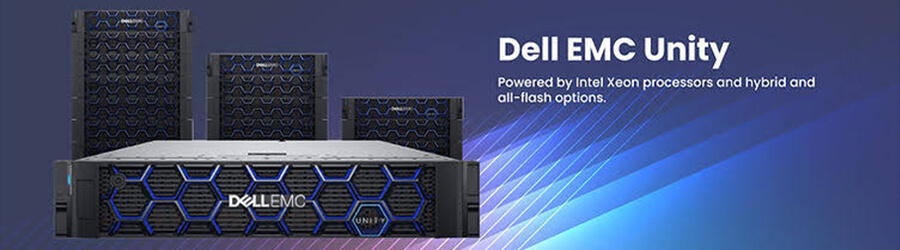
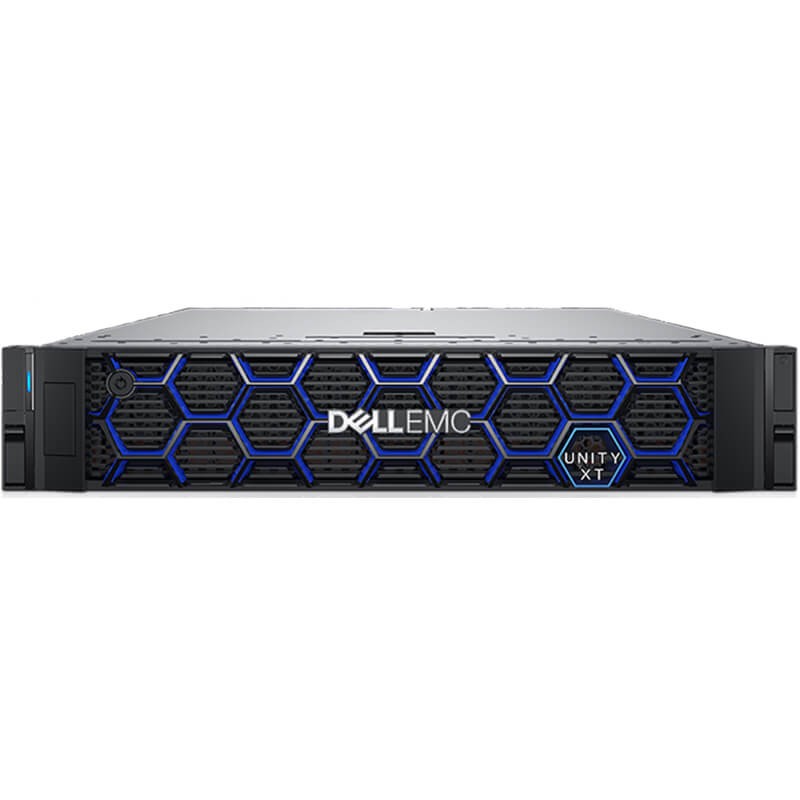
Dell Unity XT 480 is a dual-controller Unified storage array with 192 GB of system memory and Intel Dual-Socket processors providing a total of 32 cores at 1.8 GHz. The system supports up to 750 drives and up to 4 PB of raw capacity, with DAE support for capacity expansion.

Unity XT 480 supports Block, File, and VMware vVols services, along with NAS, iSCSI, and Fibre Channel protocols. It provides up to 24 Front-End ports, up to 16 Fibre Channel ports, and up to 24 10/25GbE and iSCSI ports.

The All-Flash Unity XT 480F delivers stated performance of up to 1.68 million IOPS. The system supports SAS SSDs and, in Hybrid configurations, 10K SAS and NL-SAS HDDs. It also provides capabilities such as Inline Data Reduction, Snapshot, Replication, and Data at Rest Encryption.
Quantity :
Hurry Up Only 10 Items left items

Dell Unity XT 480: In-Depth Model Overview

Unity XT 480 is one of the models in the Unity XT family and is available in two configurations: the 480F All-Flash and 480 Hybrid. This section focuses specifically on the specifications of the Unity XT 480 and the capabilities shared by the 480 and 480F versions.
Unity XT 480 uses the same Unified architecture as the rest of the family and supports Block, File, and VMware vVols services. It uses NAS, iSCSI, and Fibre Channel for connectivity to servers and network infrastructure.


Unity XT 480 Processing and Memory Specifications

Processing in Unity XT 480 is based on two Intel Dual-Socket processors, providing a total of 32 processing cores per array. The processors operate at 1.8 GHz and are designed to handle enterprise workloads and a range of storage services.
Unity XT 480 provides 192 GB of system memory per array. This memory works alongside the processing resources to manage storage operations and run various system services.
Unity XT 480 supports up to 1.2 TB of FAST Cache. Using flash memory, this capability helps improve access to frequently used data and enhance array performance.
The total cache available in a Unity XT 480 array can reach up to 1.39 TB. Therefore, the system's cache resources are not limited to FAST Cache and include the complete set of cache resources within the array architecture.
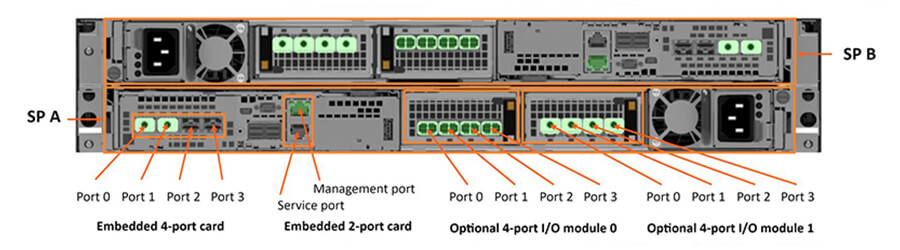
For expanded connectivity and processing capabilities, Unity XT 480 supports up to two Mezzanine cards per array.
Each Unity XT 480 array can accommodate up to four I/O modules, allowing connectivity options to be expanded according to infrastructure requirements.
On the back end, the array provides four internal SAS ports. Each port uses four lanes and operates at 12 Gb/s for communication with drives and expansion enclosures.


Unity XT 480 Scalability and Capacity

Unity XT 480 starts with a minimum of 6 SSDs or 10 HDDs and supports up to 750 drives. The maximum raw capacity is 4.0 PB, while the final capacity depends on the capacities of the selected drives.
Unity XT 480 supports up to 30 storage pools. This capability enables storage resources to be organized and allocated to different workloads.
The system can create up to 1,500 LUNs, allowing storage resources to be presented to different servers and applications as multiple logical units.
Each LUN in Unity XT 480 can be up to 256 TB in size, making large LUNs suitable for environments with substantial storage requirements.
Unity XT 480 supports up to 1,500 file systems, allowing file-based storage resources to be managed as a collection of independent file systems.
Each file system can be up to 256 TB in size, enabling the creation of large file systems for enterprise services and data.
For local protection, the system supports up to 1,500 connected Block Snapshots. This capability is used to retain Point-in-Time copies of Block data and provide rapid access to the created copies.


Unity XT 480F Performance

In the All-Flash version, Unity XT 480F, the maximum stated performance is 1.68 million IOPS. This figure is based on an internal Dell test conducted in June 2019 using 100% sequential reads, a 4 KB block size, and a Thick LUN. Dell notes that actual performance may vary depending on workload conditions.


Unity XT 480 Drives and Expansion Enclosures

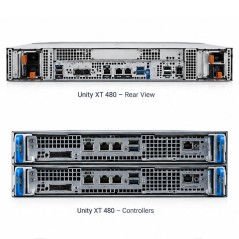
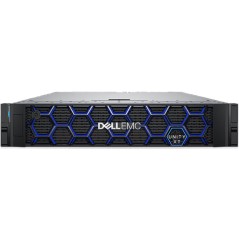
Unity XT 480 has a 2U main chassis with 25 drive bays for 2.5-inch drives. Additional capacity can be added by connecting 25-drive 2.5-inch DAEs. The platform also supports the 80-drive DAE for expanded storage capacity. In Hybrid configurations, 15-drive 3.5-inch DAEs can also be used.
SAS SSDs are available in 800 GB, 1.92 TB, 3.84 TB, 7.68 TB, and 15.36 TB capacities. In Hybrid configurations, SAS SSDs are supported in 400 GB, 800 GB, 1.6 TB, 3.2 TB, and 7.68 TB capacities, along with 10K SAS HDDs in 600 GB, 1.2 TB, and 1.8 TB capacities. 7.2K NL-SAS HDDs are also available in 4 TB, 6 TB, and 12 TB capacities.
All drives listed in the official specifications are non-SED, and Data at Rest Encryption (D@RE) is provided through the Storage Controller.


Unity XT 480 Connectivity and Protocols

Unity XT 480 uses a range of connectivity modules for network and server connections. Options include copper 10GbE, optical 10GbE, optical 25GbE, and Fibre Channel at 32 Gb/s. SAS modules operating at 12 Gb/s are used to connect DAEs to the back end.
The Unity XT 480 connectivity architecture supports up to 24 front-end ports. These ports provide connectivity between the array and hosts or the storage network.


The system supports up to 1,024 initiators/hosts, making it suitable for environments with a large number of hosts and storage connections.
With Fibre Channel connectivity, Unity XT 480 supports up to 16 Fibre Channel ports, enabling direct connections or connections through a SAN to enterprise infrastructure.
For Ethernet connectivity, the system supports up to 24 10/25GbE and iSCSI ports for high-speed connections to servers, IP networks, and storage systems.
For 1Gb Ethernet connectivity, Unity XT 480 also supports up to 24 1GbE and iSCSI ports.
Fibre Channel modules are available at 4, 8, 16, and 32 Gb/s, while Ethernet modules are used for IP and iSCSI connectivity. 12 Gb/s SAS modules are used to connect the back end and DAEs to the Storage Processors. For the 480F/480, the optional SAS I/O configuration uses four-port 12 Gb/s SAS modules; each SAS port has four lanes at 12 Gb/s, delivering 48 Gb/s nominal throughput. The 80-drive DAE can also use 8-lane connectivity through a pair of SAS ports for higher-bandwidth back-end connectivity.


Unity XT 480 Software and Management

Unity XT 480 provides a range of software and management capabilities for storage administration and optimization. Unisphere is used for system management, Unisphere Central provides centralized dashboards and alerts, and CloudIQ provides cloud-based analytics.
Thin Provisioning in Unity XT 480 allocates storage capacity according to actual data requirements, helping optimize the use of available space.
Dynamic Pools are used to create and manage storage pools, enabling flexible allocation of resources according to workload requirements.
Inline Data Reduction uses technologies such as Zero Detect, Deduplication, and Compression to reduce data consumption and improve storage efficiency.
Host Groups enable hosts to be grouped together and their connections to storage resources to be managed centrally.
Proactive Assist is designed to provide proactive support and simplify processes related to identifying and addressing system issues.
Quality of Service enables the performance of Block, File, and VMware vVols services to be controlled and managed so that storage resources can be aligned with workload requirements.
SMB Top Talkers identifies the primary consumers of SMB traffic, helping administrators better understand resource consumption patterns.
Tiering and Archiving capabilities enable data to be moved to and retained in public and private clouds and can be used to manage the data lifecycle.
File-Level Retention provides file-level retention policies for scenarios where controlling data retention periods is important.


Unity XT 480 Data Protection and Replication

For local protection, Unity XT supports Snapshot and Thin Clone for creating point-in-time copies. AppSync Basic and Dell Common Event Enabler are also included among the core capabilities.
For remote protection, native replication is available in both asynchronous and synchronous modes for Block and File data. MetroSync Manager is used to automate failover in synchronous File sessions. Snapshot Shipping and RecoverPoint Basic are also available for data protection.
Unity XT supports native migration of File and Block data from Dell VNX arrays, as well as migration from third-party arrays through SAN Copy Pull.


Unity XT 480 Security

Unity XT 480 supports Data at Rest Encryption (D@RE). This capability is provided through the Storage Controller to protect stored data against unauthorized access.
The system supports self-managed keys as well as external Key Managers compatible with the KMIP standard, enabling encryption keys to be managed according to the organization's security policies.
Unity XT 480 supports FIPS 140-2 Level 1 security for environments with defined security and cryptographic requirements.
The system supports IPv4 and IPv6 and provides Dual Stack networking capabilities.
Unity XT 480 supports SHA-2-based certificates for the system's security mechanisms and communications.
For secure communications, Unity XT 480 supports TLS 1.3 and TLS 1.2, with the option to disable the older TLS 1.0 and TLS 1.1 versions.
STIG/SRG support is also included among the security capabilities of Unity XT 480.
File-Level Retention is available in both FLR-C and FLR-E modes, allowing file retention and protection policies to be applied at the file-system level.


Unity XT 480 Virtualization and Integration

Unity XT 480 supports VMware vVols 2.0 and tools such as VASA, VAAI, and Site Recovery Manager. Dell Storage Integrator is also provided for provisioning and clone management in VMware environments.
In other environments, OpenStack Cinder and Manila, as well as Hyper-V ODX, are supported. The Unity for Ansible module also enables Unity File operations for copy and management process automation.


Unity XT 480 Physical and Power Specifications

The main Unity XT 480 chassis has a height of 2U, occupying the standard two rack units of vertical space when installed in a rack.
The Unity XT 480 chassis measures 8.72 cm in height, 44.72 cm in width, and 79.55 cm in depth. These dimensions should be considered when planning rack space and installing associated equipment.
The empty Unity XT 480 chassis weighs approximately 25.90 kg. When moving and rack-mounting the system, the weight of the installed equipment and drives should also be taken into account.
The Unity XT 480 power supply operates on single-phase power with an input voltage range of 100 to 240 VAC, ±10%. The input frequency range is 47 to 63 Hz.
The system's maximum operating current is 10.6 A at 100 VAC and 5.3 A at 200 VAC. These values are important when planning the electrical circuit and rack power capacity.
Unity XT 480 has a maximum power consumption of 1,050 W and apparent power of up to 1,060 VA. These specifications should be considered when designing the power infrastructure and sizing the UPS or PDU.
For the Unity XT 480, Dell specifies a maximum operating power of 1,060 VA (1,050 W) at both 100 VAC and 200 VAC. The maximum operating current is 10.6 A at 100 VAC and 5.3 A at 200 VAC.
The system power factor is at least 0.95 at full load, indicating efficient power utilization under full-load conditions.
Under maximum operating conditions, the Unity XT 480 can dissipate up to 3.78 × 10^6 J/hr (3,581 Btu/hr). Dell notes that power figures represent a worst-case product configuration with maximum normal values in an ambient temperature of 20°C to 25°C, and chassis power consumption may increase at higher ambient temperatures.
The system has a 45 A peak in-rush current per line cord when cold and a 120 A peak startup surge current per line cord when hot, at any line voltage. AC protection is provided by a 20 A fuse on each power supply, with a single line.
For the 480F/480 DPE, the AC inlet uses an IEC320-C20 appliance coupler per power zone at low line. The specified ride-through time is a minimum of 10 ms, and current sharing is ±5% of full load between power supplies.


Unity XT 480 Environmental Conditions

Unity XT 480F/480 through 880F/880 models are classified under ASHRAE Equipment Class A3. The recommended operating temperature range is 18°C to 27°C with a 5.5°C dew point.
The continuous allowable operating range is 5°C to 35°C, with 20% to 80% relative humidity and a maximum dew point of 21°C. Above an altitude of 950 m, the maximum allowable dry-bulb temperature is derated by 1°C per 300 m.
During limited excursion conditions, the system may operate from 35°C to 40°C, provided there is no direct sunlight on the equipment, at a -12°C dew point and 8% to 85% relative humidity with a 24°C maximum dew point (maximum wet-bulb temperature). Operation in this range is limited to no more than 10% of annual operating hours. For temperatures between 35°C and 40°C, the maximum allowable dry-bulb temperature is derated by 1°C per 175 m above 950 m.
The maximum operating altitude is 3,050 m (10,000 ft). The specified temperature gradient is 20°C per hour (36°F per hour).

DELL
10 Items

Specific References

No customer reviews for the moment.

Write your review
Dell Unity XT 480
Dell Unity XT 480

Dell Unity XT 480

$0.00
Tax Included