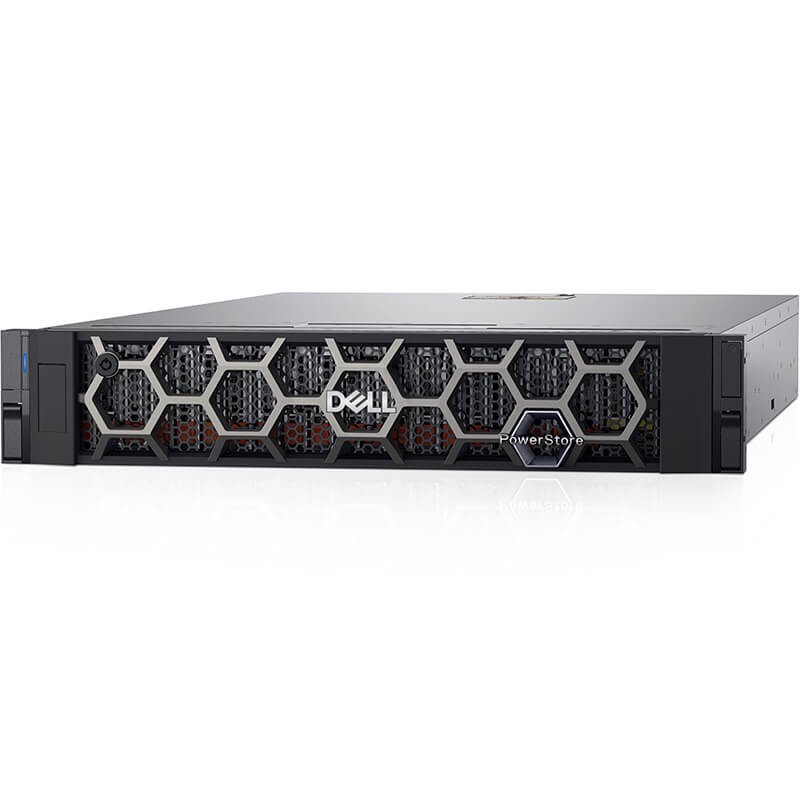
Dell PowerStore 5200
Dell PowerStore 5200 is a second-generation enterprise storage system from the PowerStore Gen 2 family; it is an integrated platform designed to simplify storage infrastructure management and respond to organizations’ changing needs.
The system supports block, file and container workloads on a single platform. With resource expansion within a single appliance and cluster expansion, it provides an infrastructure growth path aligned with business growth. Integration with management tools and automated workflows also helps simplify daily operations and container application management.
The PowerStore 5200 family is available in two models: 5200T and 5200Q. The two models share the same specifications for node count, processors, processing cores, system memory and maximum drive count; the important difference is the storage media type: 5200T uses TLC NVMe drives and 5200Q uses QLC NVMe drives. This difference also affects the achievable capacity of the base enclosure.
Second-generation architecture and storage technology
PowerStore architecture is based on Intel Xeon Scalable processors and independent controllers in an Active/Active configuration. The end-to-end All-NVMe design, dual-port NVMe SSD drives and NVMe-over-Fabric networking over Fibre Channel (FC) and TCP provide high-performance, very low-latency infrastructure for various workloads.
Always-on data reduction, intelligent automation, active resource balancing and predictive analytics help optimize the storage environment. Non-disruptive software and hardware upgrades are also capabilities of this platform.
Processors, memory and processing power
Each PowerStore 5200T or PowerStore 5200Q appliance includes two active/active nodes and uses four Intel Xeon Scalable processors in total. These processors provide a total of 96 processing cores at 2.2 GHz, and each appliance has 1152 GB of system memory. This processing and memory combination forms the hardware foundation for running enterprise workloads.
Each appliance supports up to 93 drives, and four NVRAM drives are included in its configuration. Up to two Mezzanine cards and four I/O modules can be installed. Mezzanine cards are configured one card per node in a mirrored arrangement; I/O modules are configured two modules per node in a mirrored arrangement.
Storage capacity and expansion
The PowerStore 5200 base enclosure is a 2U chassis with two active/active nodes and 25 2.5-inch NVMe drive slots. The hardware configuration table for the 5200T and 5200Q models lists a 21-drive 2.5-inch configuration, four NVRAM modules and four I/O modules.
To increase capacity, 2U expansion enclosures with 24 2.5-inch NVMe drive slots can be used. Each appliance supports up to three expansion enclosures. The base enclosure and each expansion enclosure also have two redundant power supplies.
The maximum effective capacity of the base enclosure in the 5200T model is 1.29 PBe, corresponding to a raw capacity of 323 TB or 293 TiB. In the 5200Q model, the maximum effective base enclosure capacity using 30 TB QLC drives reaches 2.59 PBe; the corresponding raw capacity of this configuration is 645 TB or 587 TiB.
The maximum announced effective capacity is 5.90 PBe per appliance and 23.60 PBe per cluster. The corresponding raw capacity per appliance is announced as 1,430 TB or 1,300 TiB. These effective capacities are calculated assuming average 5:1 data reduction and two-drive fault tolerance, and actual results depend on the environment and data used. Maximum capacities also depend on the drive sizes available at the time of purchase; the maximum supported logical capacity per appliance is 8 EB.
The 5200Q model uses QLC NVMe flash media. Maximum configurations based on this media can have up to 52 30 TB drives or 93 15 TB drives. The 2.59 PBe effective capacity for the base enclosure applies to Q-model configurations equipped with 30 TB QLC drives.
In capacity calculations, TB is decimal and equals 1000×1000×1000×1000 bytes; TiB is binary and equals 1024×1024×1024×1024 bytes. For this reason, for the same drive set, capacity is displayed differently in TB and TiB.
Supported drives
The 5200T model supports NVMe TLC SSD drives with capacities of 1.92 TB, 3.84 TB, 7.68 TB and 15.36 TB in the base enclosure and expansion enclosures. An NVMe Optane SCM SSD with 750 GB capacity is also considered for the base enclosure.
In the 5200Q model, NVMe QLC SSD drives with capacities of 15.36 TB and 30.72 TB can be used, and these media are used only in Q-model base and expansion enclosures. All drives have a 512 bytes sector size and are SED. Drives validated to FIPS 140-2 or FIPS 140-3 Level 2 are also available as an option.
Connectivity and communication ports
PowerStore 5200 uses Mezzanine cards and I/O modules to communicate with hosts and the storage network. For file access, connectivity is through NFS/SMB; for block storage, host connectivity is supported through FC and iSCSI. The maximum number of host-side ports across all types is 24.
Per appliance, up to 16 16/32Gb Fibre Channel ports, up to 24 10GBase-T/iSCSI ports, up to 24 10/25 GbE/iSCSI ports and up to 8 100 GbE/iSCSI ports are supported. Backend connectivity expansion is provided through four 100GbE QSFP ports, and four Onboard ports are included by default.
Network module options include a 4-port 10GBASE-T copper module for IP/iSCSI traffic, a 4-port optical 25 Gb/s module supporting 25GbE or 10GbE, and a 2-port 100 Gb/s QSFP module. The 4-port optical module uses SFP+ optical connections or Twinax copper connections to the Ethernet switch; the copper connection type is active/passive for 10GbE and passive for 25GbE.
For Fibre Channel-based block connectivity, a 4-port 32 Gb/s module is also available, allowing selection of 16 Gb/s or 32 Gb/s connections. This module uses multimode optical SFP and OM2, OM3 or OM4 cables for direct connection to a Host HBA or FC switch.
The ENS24 drive expansion enclosure supports 24 2.5-inch NVMe SSD drives, and its controller interface is 100 GbE QSFP. In the base enclosure and expansion enclosures, two redundant power supplies are provided for power stability.
Cluster scalability and system limits
Multiple PowerStore appliances can be combined in a horizontally scalable cluster. Up to four appliances can be placed in a Scale-out cluster. Based on system limits, a cluster supports up to 96 host-side ports, 2,048 iSCSI sessions and 2,000 initiators.
A maximum of 1,024 initiators per Initiator Group and a maximum of 32,000 Volume and vVols units per cluster are also supported. The final number of drives and the raw cluster capacity depend on the limits of each appliance. The maximum announced effective capacity per cluster is 23.60 PBe.
Storage protocols and file services
For block storage, iSCSI, Fibre Channel (FCP SCSI-3), NVMe/FC, and NVMe/TCP protocols are supported. VMware Virtual Volumes (vVols) 2.0 is also available and enables the use of vVols on FC, NVMe/FC, iSCSI and NVMe/TCP.
For file access, NFS v3, NFS v4, NFS v4.1 and NFS v4.2, as well as CIFS (SMB 1), SMB 2, SMB 3.0, SMB 3.02 and SMB 3.1.1, are included in the list of supported protocols. File transfer through FTP and SFTP is also supported.
Alongside the main protocols, features such as Access-based Enumeration (ABE) for SMB, Address Resolution Protocol (ARP), Lock Manager (NLM) in versions v1 to v4, simple Home Directory access in SMB, and Microsoft DFS as a Standalone Root Server are provided. NAS servers also support multiprotocol access for UNIX and SMB clients, including Microsoft, Apple and Samba environments.
Network and communication management capabilities include support for management and data ports with IPv4 or IPv6, Fail Safe Networking (FSN), Network Status Monitor (NSM), ICMP, virtual networking VLAN (IEEE 802.1q) and time synchronization through NTP Client. SNMP v2c and SNMP v3 with Trap support, REST API and SMTP with authentication are also supported.
For authentication and access management, capabilities such as Kerberos Authentication, LDAP, NT LAN Manager (NTLM), Dynamic Access Control (DAC) with Claims support and Network Information Service (NIS) client are supported. This platform also supports Microsoft Entra ID SSO, RSVD v1 for Microsoft Hyper-V (SMB3), direct host connection through Fibre Channel, and Network Data Management Protocol (NDMP) versions v1 to v4 with three-way support. Secure NFS v3/v4 support and VAAI and VASA interfaces are also in the feature list.
Management, automation and resource optimization
PowerStore Manager software is the main tool for managing the appliance and storage resources. Infrastructure Observability also provides cloud-based storage analytics. This suite is completed with capabilities such as Thin Provisioning, Dynamic Resiliency Engine (DRE) with single parity and dual parity, and Capacity Accounting.
Data reduction in this system is performed through Zero Detect, Deduplication and Compression. Quality of Service (QoS) is provided for managing service quality in Block, File and vVols resources. File Top Talkers also provides real-time file performance analysis.
Local data protection
Local protection capabilities of PowerStore 5200 include SED-based encryption with key management either self-managed or through an external key manager. To retain data versions at specified times, local point-in-time copies including Snapshots and Thin Clones are provided. This system also supports Immutable & Secure Snapshots.
The base software suite includes AppSync Basic, File Level Retention (FLR) and Dell Common Event Enabler with AntiVirus Agent (CEPA). These capabilities are intended to support local data protection and retention policies.
Replication, recovery and data migration
For data protection at other sites, PowerStore supports native synchronous and asynchronous replication of block data. Asynchronous vVol replication, synchronous block Metro Volume replication for VMware, Windows and Linux environments, and native synchronous and asynchronous file replication are also included in its capabilities.
In file synchronous replication scenarios, a witness at a third site can be used for automatic service failover (Auto-failover). Native integration with PowerProtect DD enables PowerStore to directly manage local backups or backups through multiple paths.
In migration, native block data migration from Unity, Unity XT, PS Series, SC Series, VNX2, VMAX3, XtremIO and third-party arrays is supported. Native file data migration is also supported for Unity, Unity XT and VNX2 arrays.
Virtualization and container infrastructure integration
For managing virtualization environments, Dell Virtual Storage Integrator (VSI) for VMware vSphere enables provisioning, management and cloning. Support for VMware Site Recovery Manager (SRM) is also available for managing Failover and Failback processes and facilitating disaster recovery. VMware VAAI and VASA interfaces and the vRO plugin are also included in the integration tool set.
In container environments and automation infrastructures, the Container Storage Interface (CSI) driver, OpenStack Cinder driver, Ansible module and Terraform Provider are supported for integration and resource management. This suite helps connect the storage system with common infrastructure management tools and automated workflows.
Security, encryption and compliance
Data at Rest Encryption (D@RE) in PowerStore 5200 is performed using self-encrypting drives (SED) from drive manufacturers for primary storage, including NVMe SSD and NVMe SCM SSD. All drives are SED, and the NVRAM cache is also encrypted. Key management for D@RE can be performed with an external KMIP-compatible key manager.
Security features include multi-factor authentication through RSA SecurID, Multiparty Authorization, Immutable & Secure Snapshots, native SHA2 certificate and IPv6 USGv6-R1 certificate.
Drives validated to FIPS 140-2 or FIPS 140-3 Level 2 are also available as an option, and the system complies with RoHS requirements.
TLS 1.3 is enabled by default, and TLS 1.1 and older versions are disabled by default; however, optional activation of TLS 1.1 is possible. For systems with STIG hardening, multi-factor authentication with Common Access Card (CAC) or Personal Identity Verification (PIV) is also supported. Common Criteria evaluation is in progress, and PowerStoreOS 3.5 is hardened according to STIG to meet the security requirements of the U.S. Department of Defense.
Power consumption and electrical specifications of the base enclosure
The base enclosure power supply operates with single-phase power and an input voltage of 200–240 VAC ±10% at 47–63 Hz. Power consumption values are provided for normal operating conditions at 26°C and maximum conditions at 40°C. In the 5200T model, line current is a maximum of 7.1 A at normal temperature and 8.8 A at maximum temperature at 200 V; in the 5200Q model, these values are 7.7 A and 9.6 A, respectively.
Typical power consumption of the 5200T model at 26°C is a maximum of 1391.2 W or 1419.6 VA; the corresponding value for the 5200Q model is a maximum of 1502.5 W or 1533.2 VA. At 40°C, maximum power consumption for the 5200T and 5200Q models is reported as 1734.4 W or 1769.8 VA and 1873.2 W or 1911.4 VA, respectively.
Typical heat dissipation at 26°C for the 5200T model is a maximum of 5.01 × 10⁶ J/hr, equivalent to 4,747 Btu/hr, and for the 5200Q model a maximum of 5.41 × 10⁶ J/hr, equivalent to 5,127 Btu/hr. Under maximum conditions at 40°C, these values are 6.24 × 10⁶ J/hr or 5,918 Btu/hr and 6.74 × 10⁶ J/hr or 6,391 Btu/hr, respectively.
Power factor at full load and 200 VAC is a minimum of 0.95. Cold inrush current per power cable and per line voltage is 45 Apk, and warm startup surge current is 120 Apk. Power protection is provided by a 20 A fuse on each power supply, and the power input type is IEC320-C14 or IEC320-C20. Input holdover time is a minimum of 10 ms, and current sharing between power supplies at full load is ±5%.
The values are calculated based on a fully populated enclosure, including power supplies, drives and I/O modules. The PowerStore 5200T model is ENERGY STAR certified.
ENS24 expansion enclosure specifications
The ENS24 expansion enclosure is designed for installing 24 2.5-inch drives and uses single-phase power with 100–240 VAC ±10% and 47–63 Hz. Its typical current at 26°C is a maximum of 4.8 A at 100 VAC and 2.4 A at 200 VAC. At 40°C, maximum current reaches 6.4 A at 100 VAC and 3.2 A at 200 VAC.
Typical power consumption of the expansion enclosure is a maximum of 470 W or 510 VA, and its maximum power consumption is 636 W or 663 VA. Power factor at full load is announced as a minimum of 0.92. Typical heat dissipation is a maximum of 1.69 × 10⁶ J/hr or 1,604 Btu/hr, and maximum heat dissipation is 2.29 × 10⁶ J/hr or 2,170 Btu/hr.
Inrush current of the expansion enclosure is a maximum of 82 A for a half line cycle and per power cable at 200 VAC, and startup surge current is a maximum of 100 Apk up to 125 µSec. Power protection is provided by a 15 A fuse on each power supply, and power input uses an IEC320-C14 device coupler for each power area. Input holdover time is a minimum of 10 ms, and current sharing between power supplies is ±5% at full load.
Empty weight of the expansion enclosure is 27.2 kg or 60 lb, and full weight is 33.5 kg or 74 lb. This enclosure is designed with a vertical size of 2 NEMA units, height of 8.89 cm, width of 43.18 cm and depth of 65.30 cm.
Base enclosure dimensions and weight
The base enclosure of the PowerStore 5200T and PowerStore 5200Q models has a vertical size of 2 NEMA units. Its empty weight is 35.80 kg or 79 lb, and its full weight is 41.7 kg or 92 lb. Chassis dimensions include height of 8.72 cm, width of 44.72 cm and depth of 79.55 cm.
Environmental conditions and operating temperature range
The recommended operating temperature range for the system is between 18°C and 27°C, equivalent to 64.4°F to 80.6°F, with a dew point of 15°C or 59°F. The allowable continuous operating range is defined as 5°C to 35°C, equivalent to 50°F to 95°F, and relative humidity in this range should be between 20% and 80%. The maximum dew point under continuous conditions is 21°C or 69.8°F.
Within the allowable continuous range, data center energy-efficiency methods such as free cooling can be used; even if these methods take equipment inlet temperature outside the recommended range, this is acceptable as long as conditions remain within the allowable continuous range. For altitudes above 950 m, the maximum allowable dry-bulb temperature must decrease by 1°C for every 300 m increase in altitude. Equivalently, the reduction is 1°F for every 547 ft above 3,117 ft.
In exceptional and non-continuous conditions, operation at 35°C to 40°C is possible without direct sunlight, with a minimum dew point of -12°C, relative humidity of 8% to 85% and maximum dew point of 24°C. These conditions are limited to a maximum of 10% of annual operating hours. At temperatures between 35°C and 40°C, for every 175 m increase in altitude above 950 m, the maximum allowable dry-bulb temperature must decrease by 1°C; equivalently, the reduction is 1°F for every 319 ft above 3,117 ft.
The maximum allowable operating altitude of the device is 3,050 m (10,000 ft). Also, the allowable rate of temperature change is 20°C/hour (36°F/hour).
Summary
Dell PowerStore 5200 is an integrated enterprise storage system from the second generation of the PowerStore family that supports block, file and container workloads in an All-NVMe architecture. Each appliance is supplied with two active/active nodes, four Intel Xeon processors, a total of 96 cores at 2.2 GHz and 1152 GB of memory. Support for up to 93 drives, four NVRAM drives and up to three expansion enclosures provides the ability to increase storage resources.
With diverse block and file protocols, cluster expansion up to four appliances, management and data reduction tools, Snapshots and replication, data-at-rest encryption and integration with virtualization and container solutions, this family offers a set of hardware and software capabilities on a single platform. The effective capacity of the base enclosure in the 5200T model is 1.29 PBe, and in the 5200Q model equipped with 30 TB QLC drives it is 2.59 PBe.