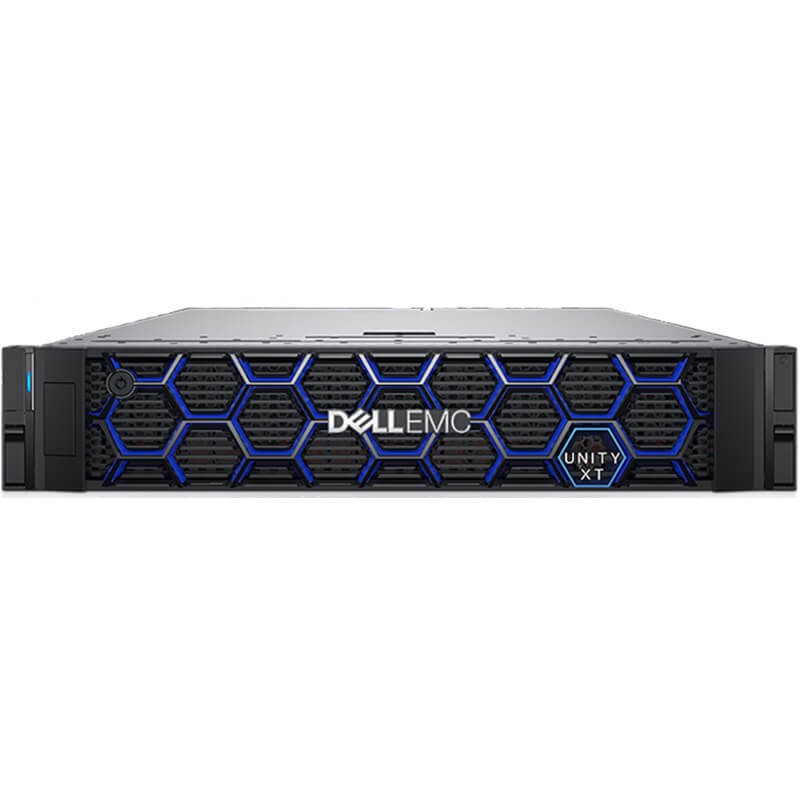
Dell Unity XT 380 | Enterprise Storage Array
The Dell Unity XT 380 is a unified storage array designed for enterprise IT environments. It provides a unified architecture for block, file, and VMware vVols storage, while simultaneously supporting the native NAS, iSCSI, and Fibre Channel protocols. Its architecture is based on two active storage processors (Dual Active) and a 12 Gb/s SAS back-end connection.
The Dell Unity XT family includes both hybrid and all-flash models. The Unity XT 380 is the hybrid-flash array (HFA), while the Unity XT 380F is the all-flash array (AFA) in this family. These two configurations are designed to address different capacity, performance, and workload requirements.
System Processing Power and Memory
The Dell Unity XT 380 uses two Intel processors, providing a total of 12 processing cores per array, each running at 1.7 GHz. The system memory is 128 GB per array.
In the Unity XT 380 hybrid configuration, FAST Cache can provide up to 800 GB per array. The total cache capacity is up to 928 GB. These figures apply to hybrid arrays.
Scalability and Storage Capacity
The Dell Unity XT 380 requires a minimum of 6 SSD drives or 10 HDD drives in its base configuration and supports up to 500 drives. Its maximum raw capacity is 2.4 PB, depending on the drive capacities available at the time of purchase.
The system supports up to 20 storage pools and 1,000 LUNs per array. The maximum size of each LUN is 256 TB. It can also create up to 1,000 file systems, each with a maximum size of 256 TB, and maintain up to 1,000 attached block-level snapshots.
Each array supports up to 4 I/O modules. A Mezzanine card is not listed for the 380 model in the specifications table (NA). The four embedded SAS ports, each with 4 lanes at 12 Gb/s, provide the back-end connection. The base and maximum number of back-end SAS buses is 2 4-lane paths, and no separate optional SAS port is listed for this model. Supported RAID options include RAID 1/0, RAID 5, and RAID 6.
Dell Unity XT 380F Performance
The Dell Unity XT 380F is the all-flash version of this system and is designed for workloads that require all-flash storage.
According to Dell internal testing conducted in June 2019, the all-flash 380F delivers up to 600,000 IOPS. The test conditions included 100% sequential reads, a 4 KB block size, and a Thick LUN. Actual results may vary.
The stated IOPS figure applies to the 380F all-flash model under the specified test conditions. It should not be considered guaranteed performance for every workload or configuration.
Drives and Expansion Enclosures
The Dell Unity XT 380 supports SAS SSD drives and, in the hybrid configuration, SAS and NL-SAS hard disk drives. The disk processor enclosure (DPE) occupies 2U of rack space and provides 25 slots for 2.5-inch drives.
Supported disk-array enclosure (DAE) options include:
One 2U enclosure with 25 2.5-inch drive slots.
In the hybrid configuration, one 3U enclosure with 15 3.5-inch drive slots is also supported.
The all-flash 380F supports 2.5-inch drives in a 2U tray with 25 slots. In addition to this option, the hybrid 380 supports 3.5-inch drives in a 3U tray with 15 slots.
The minimum number of drives in a system configuration is 6 SSDs or 10 HDDs. Supported SAS SSD capacities in the all-flash model include 800 GB, 1.92 TB, 3.84 TB, 7.68 TB, and 15.36 TB. In the hybrid model, 400 GB SSDs (for FAST Cache and Mixed Pools), as well as 800 GB, 1.6 TB, 3.2 TB, and 7.68 TB SSDs, are supported for the specified uses. 10K SAS hard drives are available in 600 GB, 1.2 TB, and 1.8 TB capacities, while 7.2K NL-SAS drives are available in 4 TB, 6 TB, and 12 TB capacities in the 3.5-inch enclosure. Each system requires 4 system drives; in the 380 model, 107 GB of each system drive is used for the operating environment software and data structures.
The range of supported drives and enclosures allows the hybrid 380 and all-flash 380F models to be configured according to capacity and performance requirements.
Connectivity and Protocols
The Dell Unity XT 380 provides the connectivity required for servers and storage networks. The maximum number of front-end ports per array is 20, and the maximum number of initiators is 512. With two storage processors (Dual SP), the system supports up to 64 hosts; in a single-processor configuration (Single SP), it supports up to 32 hosts.
Connectivity options and limits per array include:
• Up to 20 Fibre Channel (FC) ports.
• Up to 20 1 Gbase-T/iSCSI ports.
• Up to 20 10 GbE/iSCSI ports or up to 16 25 GbE/iSCSI ports.
• Four-port Fibre Channel I/O modules support auto-negotiated speeds of 4/8/16 Gbps or 8/16/32 Gbps, depending on the module type.
This model has 4 embedded CNA ports, which can provide FCD connectivity at 8/16 Gb, IP/iSCSI connectivity at 10 Gb, or 1 Gb connectivity through RJ45. A separate embedded 10Gbase-T port is not listed for this model. The unified architecture provides block and file access through Fibre Channel, iSCSI, and NAS.
Storage Management and Performance Optimization
The Dell Unity XT 380 offers a suite of software for storage management, monitoring, capacity provisioning, and performance optimization. Unisphere provides element management, Unisphere Central offers a unified dashboard and alerting, and CloudIQ provides cloud-based storage analytics for administrators.
Key software features include:
• Thin Provisioning
• Dynamic Pools
• Inline Data Reduction
• Zero Detect
• Deduplication and Compression
• Host Groups
• Quality of Service (QoS)
• SMB Top Talkers
• FAST Cache and FAST VP for hybrid arrays
• File-Level Retention (FLR-E and FLR-C)
Thin Provisioning and Dynamic Pools enable flexible allocation of storage resources. Inline Data Reduction includes zero detection, deduplication, and compression. Quality of Service is supported for block, file, and vVols workloads.
FAST Cache and FAST VP provide performance and efficiency optimization for hybrid arrays. On the Unity XT 380, FAST Cache is up to 800 GB, and total cache capacity is up to 928 GB. File-Level Retention supports Enterprise (FLR-E) and Compliance (FLR-C) modes.
Protocols and Software Integration
The Dell Unity XT 380 supports block and file storage protocols as well as VMware Virtual Volumes. The platform also integrates with virtualization environments, containers, and management tools.
Supported protocols and interfaces include:
• File protocols: NFS v3, NFS v4, NFS v4.1, CIFS/SMB 1, SMB 2, SMB 3.0, SMB 3.02, and SMB 3.1.1.
• File transfer: FTP and SFTP.
• Block protocols: Fibre Channel (FCP SCSI-3) and iSCSI.
• Virtualization: VMware Virtual Volumes (vVols) 2.0.
• Management: REST API, SNMP v2c/v3, and NTP.
• Directory and authentication services: LDAP/LDAP SSL and Kerberos.
• Data management: Network Data Management Protocol (NDMP), versions v1 through v4.
• Container integration: Container Storage Interface (CSI) driver.
Virtualization integrations include VMware VASA and VAAI, VMware Site Recovery Manager, and Dell Virtual Storage Integrator (VSI). The platform also supports OpenStack Cinder and Manila drivers, Hyper-V Offloaded Data Transfer (ODX), Offload Copy for File, and the Ansible module for Unity.
Other supported components include Dell Common Event Enabler, AntiVirus Agent, and Event Publishing Agent, as well as the management and networking services of the Unity OE platform.
Data Protection and Disaster Recovery
The Dell Unity XT 380 provides local and remote data protection capabilities. Local point-in-time copies include Snapshots and Thin Clones, and the software also provides native block and file replication.
Available features include:
• Local point-in-time copies: Snapshots and Thin Clones.
• AppSync Basic.
• Native asynchronous and synchronous block and file replication.
• MetroSync Manager: optional software for automating failover of file synchronous-replication sessions.
• Snapshot Shipping.
• Dell RecoverPoint Basic.
• Native block and file migration from legacy Dell VNX systems, and integrated block migration from third-party arrays using SAN Copy Pull.
Optional solutions include AppSync Advanced, Dell RecoverPoint Advanced, Dell RP4VM, PowerPath Migration Enabler, and PowerPath Multipathing.
Other optional solutions listed for the Unity platform include Connectrix SAN, Dell data-protection hardware and software platforms, Unity XT metro node, and VPLEX. Availability depends on the selected product and configuration.
Security and Data Protection
The Dell Unity XT 380 supports the security and compliance capabilities of the Dell Unity XT platform.
Key security and compliance features include:
• Controller-based encryption of data at rest (D@RE, optional) with self-managed keys.
• KMIP-compliant external key manager for D@RE.
• FIPS 140-2 Level 1 validation.
• IPv6 and dual-stack IPv4 modes.
• Native SHA-2 certificate.
• Support for TLS 1.2 and TLS 1.3.
• TLS 1.0 and TLS 1.1 deactivation.
• Security Technical Implementation Guide (STIG) and Security Requirements Guide (SRG).
• File-Level Retention: Enterprise FLR-E and Compliance FLR-C, with requirements related to SEC Rule 17a-4(f).
D@RE provides controller-based encryption of data at rest and can use either self-managed keys or a KMIP-compliant external key manager. Other listed capabilities include FIPS 140-2 Level 1 validation, IPv4/IPv6 operation, SHA-2 certificates, TLS support, and File-Level Retention.
Physical Dimensions, Weight, and Power Consumption
The disk processor enclosure (DPE) in the Dell Unity XT 380 has the following physical specifications:
• Height: 8.88 cm (3.5 in)
• Width: 44.76 cm (17.62 in)
• Depth: 61.39 cm (24.17 in)
• Empty weight: 24.60 kg (54.11 lb); vertical size: 2 NEMA units.
The DPE uses single-phase AC power. The input voltage range is 100 to 240 VAC, with a tolerance of ±10%, and the frequency range is 47 to 63 Hz.
The maximum input current is 10.07 A at 100 VAC and 5.04 A at 200 VAC. Maximum power consumption at both 100 and 200 VAC is 1,007 VA (970.5 W). The power factor at full load is at least 0.95, and maximum heat dissipation is 3.49 × 10⁶ J/hr (3,311 Btu/hr).
Maximum cold-start inrush current is 45 Apk, and warm-start surge current is 120 Apk per power cable. AC protection is provided by a 15 A fuse on each power supply, with IEC320-C14 (High Line) and IEC320-C20 (Low Line) inputs. Ride-through time is at least 10 ms, and current sharing between power supplies is within ±5% of full load. Power values are specified for a fully populated enclosure at an ambient temperature of 20 to 25°C and may increase at higher ambient temperatures.
Each DPE and DAE enclosure has 2 power supplies. If one supply fails or is removed, the other can provide power to the entire module. During a power outage, the battery backup unit (BBU) in the SP enclosure supplies the required power to one module or power zone.
Operating Environment and Temperature
The Dell Unity XT 380 and 380F models meet ASHRAE Equipment Class A4 requirements.
The recommended operating temperature range is 18 to 27°C at a dew point of 5.5°C.
For continuous operation, the allowable ranges are as follows:
• Dry-bulb temperature: 5 to 35°C.
• Relative humidity: 20% to 80%.
• Maximum dew point: 21°C.
At altitudes above 950 m, the maximum allowable dry-bulb temperature must be reduced by 1°C for every 300 m increase in altitude.
Under uncommon operating conditions, the system can operate without direct sunlight at 35 to 40°C, with a dew point of -12°C and relative humidity of 8% to 85%; the maximum dew point in this condition is 24°C. Operation within this range is limited to a maximum of 10% of the annual operating hours.
At temperatures of 35 to 40°C, the maximum allowable dry-bulb temperature must be reduced by 1°C for every 175 m increase in altitude above 950 m. The maximum operating altitude is 3,050 m, and the allowable temperature gradient is 20°C per hour.
Under exceptional A4-class conditions, operation at 40 to 45°C without direct sunlight is possible, with a dew point of -12°C and relative humidity of 8% to 90%; this condition is limited to a maximum of 1% of the annual operating hours. The maximum dew point is 24°C. At temperatures of 35 to 45°C, the allowable dry-bulb temperature must be reduced by 1°C for every 125 m increase in altitude above 950 m.
Summary
The Dell Unity XT 380 is an enterprise unified storage array for block, file, and VMware vVols workloads. It uses two Intel processors with a total of 12 cores running at 1.7 GHz and provides 128 GB of memory per array. It scales to 500 drives and a maximum raw capacity of 2.4 PB, and supports 20 storage pools, 1,000 LUNs, and 1,000 file systems.
Under the specified internal test conditions, the all-flash Unity XT 380F delivers up to 600,000 IOPS. In the 380 hybrid configuration, FAST Cache is up to 800 GB and total cache capacity is up to 928 GB. Key software capabilities include inline data reduction, Snapshots, native replication, and data-at-rest encryption.
Connectivity includes up to 20 front-end ports, up to 20 Fibre Channel ports, up to 20 1 Gbase-T/iSCSI ports, and up to 20 10 GbE ports or 16 25 GbE ports. The DPE occupies 2U of rack space and provides 25 2.5-inch drive slots. The 380 and 380F models comply with the ASHRAE A4 environmental class.