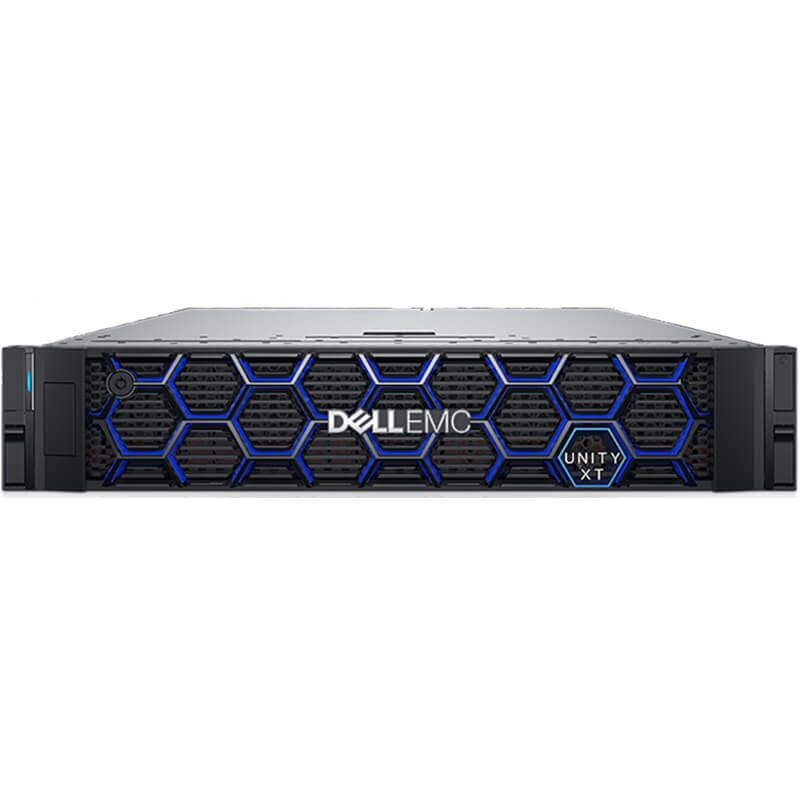
Dell Unity XT 680 is a dual-controller unified storage array with 384 GB of system memory and Intel Dual-Socket processors providing a total of 48 cores at 2.1 GHz. The system supports up to 1,000 drives and up to 8 PB of raw capacity, with DAE support for capacity expansion.
Unity XT 680 supports Block, File, and VMware vVols services, along with NAS, iSCSI, and Fibre Channel protocols. It provides up to 24 front-end ports, up to 16 Fibre Channel ports, and up to 24 10/25GbE and iSCSI ports.
The all-flash Unity XT 680F delivers stated performance of up to 2.36 million IOPS. The system supports SSDs and, in Hybrid configurations, 10K SAS and NL-SAS HDDs. Key features include Inline Data Reduction, Snapshots, Replication, and Data at Rest Encryption.
Dell Unity XT 680 is a unified storage system for enterprise IT infrastructure. It combines block and file storage on one platform. The system supports physical servers, virtualized environments, and business applications. Its scalable design offers flexible connectivity, storage management, and data protection. The Unity XT family includes hybrid models and the all-flash Dell Unity XT 680F. These options help organizations match storage performance and capacity to their workloads.
Processing Power and System Memory
Dell Unity XT 680 uses a dual-socket Intel architecture. It provides 48 processor cores running at 2.1 GHz. The system also includes 384 GB of memory. These resources support multiple storage operations, virtual machines, and enterprise applications. In hybrid configurations, FAST Cache provides up to 3.2 TB of cache capacity. Total cache capacity can reach 3.58 TB. This helps speed up access to frequently used data and supports changing workloads.
Scalability and Storage Capacity
Dell Unity XT 680 supports growing enterprise data needs. It can accommodate up to 1,000 drives and provide up to 8 PB of raw capacity. The system supports up to 40 storage pools and 2,000 LUNs. Each LUN can reach 256 TB. It also supports up to 2,000 file systems, each with a maximum size of 256 TB. Up to 2,000 snapshots are supported. Expansion options include up to two mezzanine cards and four I/O modules. Four embedded SAS ports provide 12 Gbps connectivity. Each port uses four lanes.
Dell Unity XT 680F Performance
Dell Unity XT 680F is the all-flash version of the system. It is designed for workloads that require high I/O performance and low latency. Dell's internal test in June 2019 recorded up to 2.36 million IOPS. The test used 100% sequential reads, a 4 KB block size, and a thick LUN. Actual performance varies with system configuration, workload, access patterns, and applications. The all-flash architecture suits databases, virtualization platforms, and other enterprise applications that need fast storage access.
Drives and Expansion Enclosures
Dell Unity XT 680 supports multiple drive types and expansion enclosures. The Disk Processor Enclosure (DPE) occupies 2U of rack space. It holds 25 2.5-inch drives. Supported Disk Array Enclosure (DAE) options include: • A 2U enclosure with 25 2.5-inch drives. • A 3U enclosure with 80 2.5-inch drives. • A 3U enclosure with 15 3.5-inch drives for hybrid models. The minimum configuration requires six SSDs or ten HDDs. Supported 10K SAS HDD capacities are 600 GB, 1.2 TB, and 1.8 TB. The system also supports 7.2K NL-SAS HDDs in 4 TB, 6 TB, and 12 TB capacities. SSD options are available for supported configurations. Combining SSDs and HDDs helps organizations balance performance, capacity, and cost.
Connectivity and Protocols
Dell Unity XT 680 offers flexible connectivity for servers, networks, and applications. It supports up to 24 front-end ports and 1,024 initiators. With dual Storage Processors (SPs), the system supports up to 64 hosts. A single-SP configuration supports up to 32 hosts. Connectivity options include: • Up to 16 Fibre Channel (FC) ports. • Up to 24 1GbE/iSCSI ports. • Up to 24 10/25GbE/iSCSI ports. • Fibre Channel speeds of 4, 8, 16, and 32 Gbps. Fibre Channel and iSCSI provide block-level storage access. Supported network protocols enable file-level services. These options help integrate the system into existing enterprise networks and storage environments.
Storage Management and Performance Optimization
Dell Unity XT 680 includes tools for storage management, monitoring, and optimization. Unisphere and Unisphere Central provide system management capabilities. CloudIQ adds cloud-based monitoring and analytics in supported environments. Key features include: • Thin Provisioning • Dynamic Pools • Inline Data Reduction • Zero Detect • Deduplication and Compression • Host Groups • Quality of Service (QoS) • SMB Top Talkers • FAST Cache and FAST VP • FLR-E and FLR-C Thin Provisioning and Dynamic Pools help allocate storage capacity efficiently. Inline Data Reduction, Zero Detect, Deduplication, and Compression can reduce physical storage needs. QoS helps manage performance across different workloads. FAST Cache and FAST VP optimize data access in supported configurations. FLR-E and FLR-C provide file-level retention capabilities.
Protocols and Software Integration
Dell Unity XT 680 supports both block and file storage protocols. It also integrates with virtualization platforms and management tools. Supported protocols and interfaces include: • File protocols: NFS v3, NFS v4, NFS v4.1, CIFS/SMB 1, SMB 2, SMB 3.0, SMB 3.02, and SMB 3.1.1. • File transfer: FTP and SFTP. • Block protocols: Fibre Channel (FC) and iSCSI. • Virtualization: VMware vVols 2.0. • Management: REST API, SNMP v2c/v3, and NTP. • Directory and authentication services: LDAP/LDAPS and Kerberos. • Data management: NDMP. • Container integration: Container Storage Interface (CSI). VMware integration options include VASA/VAAI, VMware Site Recovery Manager, and Dell Virtual Storage Integrator (VSI). The system also supports OpenStack Cinder and Manila, Hyper-V ODX, Offloaded File Copy, and the Ansible module for Unity. Additional integrations include Dell Common Event Enabler, AntiVirus Agent, and Event Publishing Agent. These tools support event management, antivirus integration, and the transfer of system information to compatible applications.
Data Protection and Disaster Recovery
Dell Unity XT 680 provides features for data protection, recovery, and business continuity. Snapshot and Thin Clone help preserve data states. They also support efficient use of storage capacity. Available features include: • Snapshot and Thin Clone • AppSync Basic • Asynchronous and synchronous replication • MetroSync Manager • Snapshot transfer • RecoverPoint Basic • Native migration from Dell VNX and migration through SAN Copy Pull Optional solutions can extend these capabilities. They include AppSync Advanced, Dell RecoverPoint Advanced, and RecoverPoint for VMs. PowerPath Migration Enabler supports data migration. PowerPath Multipathing manages multiple paths to storage. Connectrix SAN, Dell data protection solutions, Unity XT metro node, and VPLEX can support integration and business continuity in compatible architectures. Available features depend on configuration, licensing, and integrated systems.
Security and Data Protection
Dell Unity XT 680 includes security features for stored data and system access. Key capabilities include: • Data at Rest Encryption (D@RE) • Key Management Interoperability Protocol (KMIP) • FIPS 140-2 Level 1 • IPv4/IPv6 Dual Stack • SHA-2 • TLS 1.2 and TLS 1.3 • The option to disable TLS 1.0 and TLS 1.1 • Security Technical Implementation Guide (STIG) and Security Requirements Guide (SRG) • FLR-E and FLR-C D@RE encrypts data at rest. KMIP enables integration with compatible key management systems. TLS and SHA-2 help protect communications and data exchanges in supported configurations.
Physical Dimensions, Weight, and Power
The Dell Unity XT 680 Disk Processor Enclosure (DPE) has the following dimensions without rails: • Height: 8.72 cm • Width: 44.72 cm • Depth: 79.55 cm • Weight: 25.9 kg The system uses single-phase AC power. Input voltage ranges from 100 to 240 VAC ±10%. The supported frequency range is 47–63 Hz. Maximum current is 11.72 A at 100 V and 5.86 A at 200 V. Maximum apparent power is 1,172 VA at both voltages. Maximum real power is 1,161 W at 100 V and 200 V. The power factor is at least 0.95. These specifications help with rack planning, power provisioning, and cooling assessments in server rooms and data centers.
Operating Environment and Temperature
Dell Unity XT 680 has defined environmental requirements for reliable operation. The system is associated with ASHRAE Equipment Class A3. The recommended operating temperature is 18–27°C. The recommended dew point is 5.5°C. For continuous operation, the specified ranges are: • Dry-bulb temperature: 5–35°C • Relative humidity: 20–80% • Maximum dew point: 21°C Above 950 m altitude, the maximum dry-bulb temperature must decrease by 1°C for every additional 300 m. Under exceptional conditions, the system can operate at 35–40°C for up to 10% of annual operating hours. Avoid direct sunlight. The dew point must be at least -12°C, relative humidity must remain between 8% and 85%, and wet-bulb temperature must not exceed 24°C. At temperatures between 35°C and 40°C, the maximum dry-bulb temperature must decrease by 1°C for every additional 175 m above 950 m. The maximum operating altitude is 3,050 m. Temperature changes must not exceed 20°C per hour.
Dell Unity XT 680 is a dual-controller unified storage array with 384 GB of system memory and Intel Dual-Socket processors providing a total of 48 cores at 2.1 GHz. The system supports up to 1,000 drives and up to 8 PB of raw capacity, with DAE support for capacity expansion.
Unity XT 680 supports Block, File, and VMware vVols services, along with NAS, iSCSI, and Fibre Channel protocols. It provides up to 24 front-end ports, up to 16 Fibre Channel ports, and up to 24 10/25GbE and iSCSI ports.
The all-flash Unity XT 680F delivers stated performance of up to 2.36 million IOPS. The system supports SSDs and, in Hybrid configurations, 10K SAS and NL-SAS HDDs. Key features include Inline Data Reduction, Snapshots, Replication, and Data at Rest Encryption.